

Concern to Protocol · Chapter 1 of 4
The short answer
It depends on two things: where the pigment is, and how your skin reacts. Underarms, inner thighs and other body areas call for the body protocol. Reactive facial skin starts with the sensitive face protocol. Defined patches such as melasma, marks or sun spots call for the hypermelanogenesis protocol. A dull, uneven tone without defined spots fits the healthy aging protocol.
- 01Same cell, four situations. Your melanocytes do not behave the same way on a reactive cheek, an underarm or aging skin.
- 02Three questions are enough to choose: where is it, how does your skin react, what do you see.
- 03Every protocol follows the same logic: correct, support, maintain. 12 to 16 weeks of correction, then maintenance.
- 04One protocol per area at a time. TOTAL SKIN is the only step all four share.*
In October, we went inside the melanocyte, the cell behind every dark spot. Since then, one question keeps coming back in your messages: "OK, but which routine is for me?" Here is the answer, in three questions.
Why isn't there one routine for every dark spot?
Because the melanocyte is the same everywhere, but what wakes it up is not. On the face, sun, heat and hormones drive melasma. After a breakout, an eczema flare or a harsh product, inflammation leaves a mark behind, and this happens more often and more intensely on deeper skin tones.[4] On the body, the usual suspects are friction, shaving and sweat. With age, melanocytes respond unevenly. The global expert consensus on hyperpigmentation treats each of these conditions separately and stresses long-term management.[1] That is why we built four protocols, not one.

Question 1: Where is the pigment?
Start with the map. Body skin in folds and creases is warm, damp, rubbed and often shaved, so it reacts differently from the face and corrects more slowly. Darker underarms are one of the most common pigment complaints.[5]
- Underarms, inner thighs, bikini line, elbows, knees or neck: go to the body protocol.
- Face: go to question 2.
Question 2: Does your facial skin react easily?
If your skin stings with acids, turns red with new products, or you are dealing with marks left by acne or eczema, start gentle. On reactive skin, irritation itself can trigger more pigment, so the correction step has to build tolerance first.[4]
- Yes, it reacts: go to the sensitive face protocol. You can move on to INTENSIVE later, once your skin tolerates it.
- No, it is fairly resilient: go to question 3.
Question 3: What do you see in the mirror?
Look in daylight, without makeup. Are you seeing defined spots, or an overall tone that looks uneven and tired?
- Defined spots: symmetrical patches (melasma), marks after acne (post-inflammatory hyperpigmentation) or sun spots. Go to the hypermelanogenesis protocol. Its cysteamine complex has been compared with a reference treatment in melasma, with a measurable change from week 4.[2] Stabilized cysteamine 5% has also been studied on acne marks.[3]
- An uneven, dull or patchy tone, without defined spots: go to the healthy aging protocol.
The four protocols at a glance
| Protocol | For | What is in it |
|---|---|---|
| Hypermelanogenesis | Melasma, post-acne marks, sun spots | INTENSIVE, short contact then rinse. TOTAL SKIN.* |
| Sensitive face | Marks on skin that reacts easily | SENSITIVE, short contact then rinse. AGELESS. TOTAL SKIN.* |
| Body and intimate areas | Underarms, inner thighs, bikini line (outer skin only), elbows, knees, neck | SENSITIVE, short contact then rinse. TOTAL SKIN.* |
| Healthy aging | Uneven, dull, tired-looking tone | AGELESS daily. TOTAL SKIN.* |
What do all four protocols have in common?
The same three-part logic, which we unpacked in The Pigment Care Protocol:
Correct. A targeted topical step works on the look of pigment. In three of the four protocols, it is a cysteamine cream left on for a short time, then rinsed.
Support. TOTAL SKIN brings antioxidant support from the inside: 4 capsules a day, 2 and 2 or all 4 with a meal.*
Maintain. After 12 to 16 weeks, fewer correction sessions and daily protection, because the triggers are still there.
Still not sure? Our protocols page has a short quiz: nine questions, two minutes, no photo. And if a spot appeared suddenly, changes shape or color, or the skin feels thick and velvety, see a dermatologist before starting anything.
- Chapter 1Which protocol is right for me?You are here
- Chapter 2Darker underarms and inner thighsRead it
- Chapter 3Dark marks on sensitive skinComing Monday
- Chapter 4Dull, patchy, tired-looking skinComing Thursday
Find your protocol
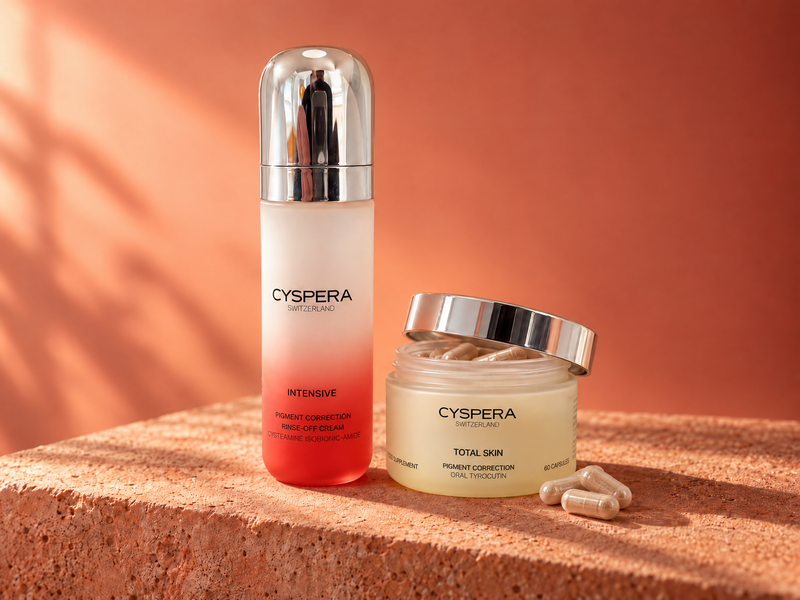
Hypermelanogenesis
Melasma, marks and sun spots. INTENSIVE and TOTAL SKIN.*
See the protocol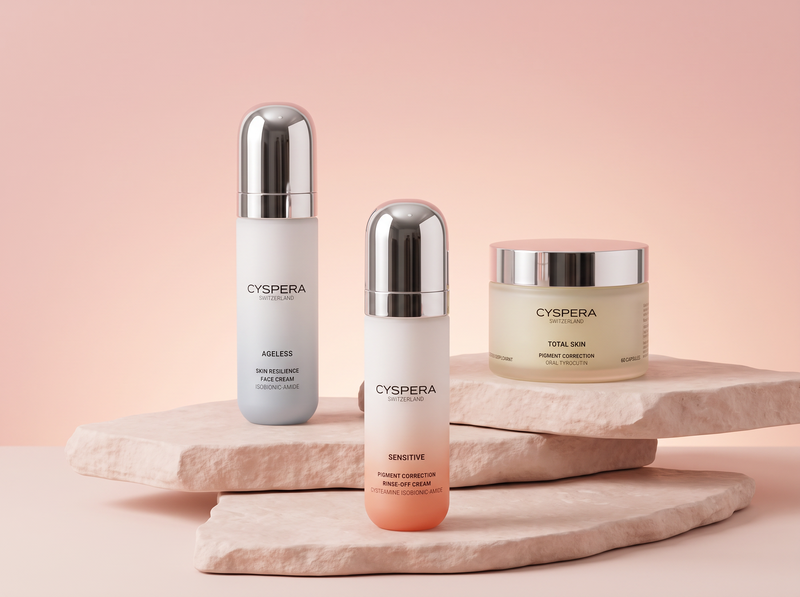
Sensitive face
Marks on reactive skin. SENSITIVE, AGELESS and TOTAL SKIN.*
See the protocol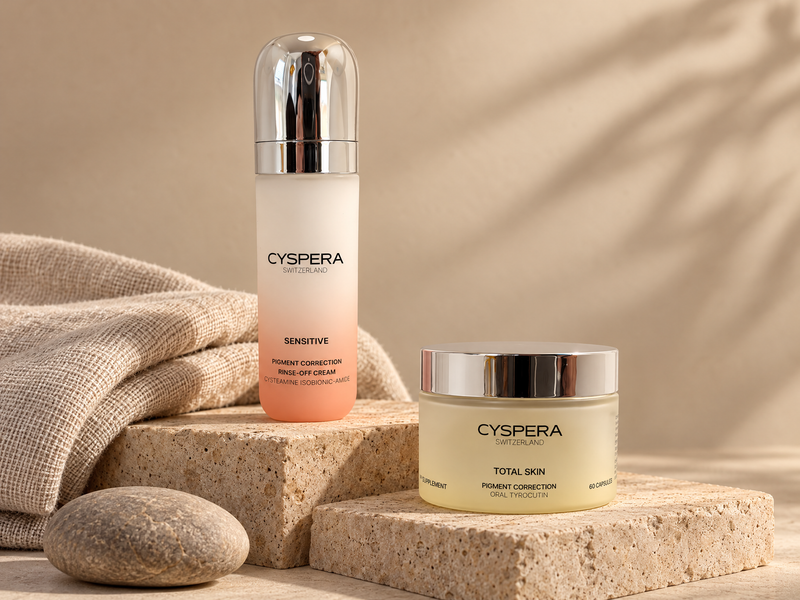
Body and intimate areas
Underarms, inner thighs, bikini line. SENSITIVE and TOTAL SKIN.*
See the protocol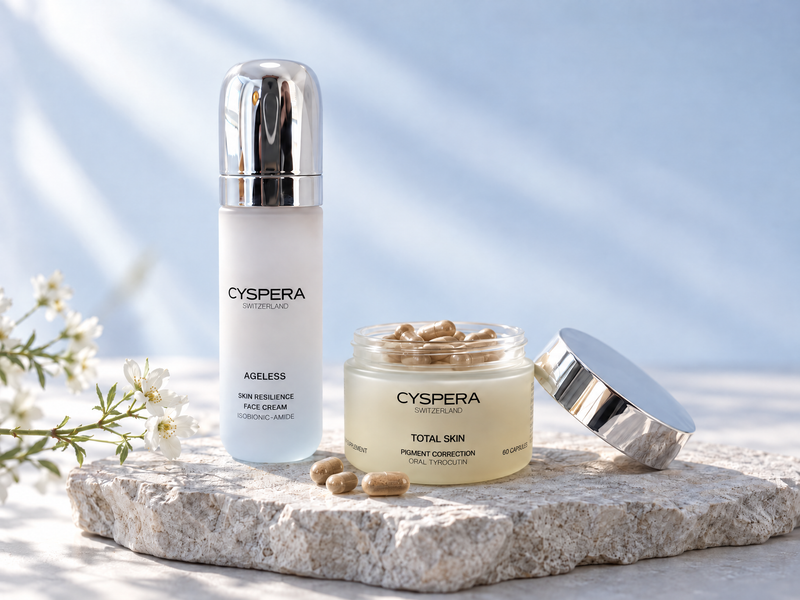
Healthy aging
Uneven, dull tone. AGELESS and TOTAL SKIN.*
See the protocolFrequently asked questions
Can I follow two protocols at the same time?
Not on the same area. You can follow one protocol on your face and another on your body, for example the sensitive face protocol and the body protocol. TOTAL SKIN is shared by all four, so you only take it once.
I have dark spots and my skin is reactive. Where do I start?
Start with the sensitive face protocol. Once your skin tolerates the correction step well, you can move on to the hypermelanogenesis protocol with INTENSIVE.
How long before I see a difference?
On the face, first changes often show from around week 4. Body skin is slower. Give any protocol its full correction phase of 12 to 16 weeks: the best results usually show from 3 months. Compare photos taken in the same light.
Do I need a dermatologist to choose?
Not to choose, but see one if you are unsure what you are looking at, if a spot appeared suddenly or changes, if the skin feels thick and velvety, or if you are pregnant or breastfeeding.
Are the protocols suitable for deeper skin tones?
Yes, Cyspera is formulated for all skin tones. Deeper skin is more prone to marks from irritation, so start with a few evenings a week and keep other actives out of the same evening.
References
- Passeron T, et al. Global consensus on the management of melanin hyperpigmentation disorders. Journal of the European Academy of Dermatology and Venereology. 2025. doi:10.1111/jdv.70185.
- Sachdev M, Grimes PE, Callender V, Hartman CL, Taylor SC, Elbuluk N, Badawi A, Funasaka Y, Lim J, Ng CY, Desai SR. Cysteamine isobionic-amide complex versus Kligman's formula for the treatment of melasma: equal efficacy and rapid onset of action. Journal of Drugs in Dermatology. 2024;23(2):9-16. doi:10.36849/JDD.7428.
- Ahmadi K, et al. Assessing the effectiveness of stabilized cysteamine 5% cream compared to hydroquinone 4%/ascorbic acid 3% combination cream in treating acne-induced post-inflammatory hyperpigmentation: a randomized, controlled study. Journal of Clinical and Aesthetic Dermatology. 2024;17(4):37-41. PMID 38638185.
- Davis EC, Callender VD. Postinflammatory hyperpigmentation: a review of the epidemiology, clinical features, and treatment options in skin of color. Journal of Clinical and Aesthetic Dermatology. 2010;3(7):20-31. PMID 20725554.
- Vahabi SM, Sajjadi S, Kalantari Y, Pourgholi E, Heidari S, Etesami I. Axillary hyperpigmentation treatment: a systematic review of the literature. Journal of Cosmetic Dermatology. 2025;24(8):e70418. PMID 40843925.
*These statements have not been evaluated by the Food and Drug Administration. This product is not intended to diagnose, treat, cure, or prevent any disease.
The Cyspera Science Team and the reviewer work for Scientis SA, the company behind Cyspera. The 2024 Sachdev study was sponsored by Scientis. Availability of CYSPERA INTENSIVE varies by country. This article is educational and is not medical advice. CYSPERA topical products are cosmetics and are not intended to diagnose, treat, cure or prevent any disease. Last updated November 12, 2026.


